Handmade candlesWhat it is
Handmade candles. $42. That is the whole ad.
Picture: The handmade candles on a plain background, filling the frame. Nothing else in shot.
Shop nowEight specialists. One conversation.
Describe your business in a sentence. Eight specialists work out where it runs, who sees it, what the ads say and what happens on day four - then it runs, and tells you the truth about what actually happened.
You type
It is also the only one that will tell you no. If finding a customer costs more than that customer earns you, it refuses to start and shows you the arithmetic.
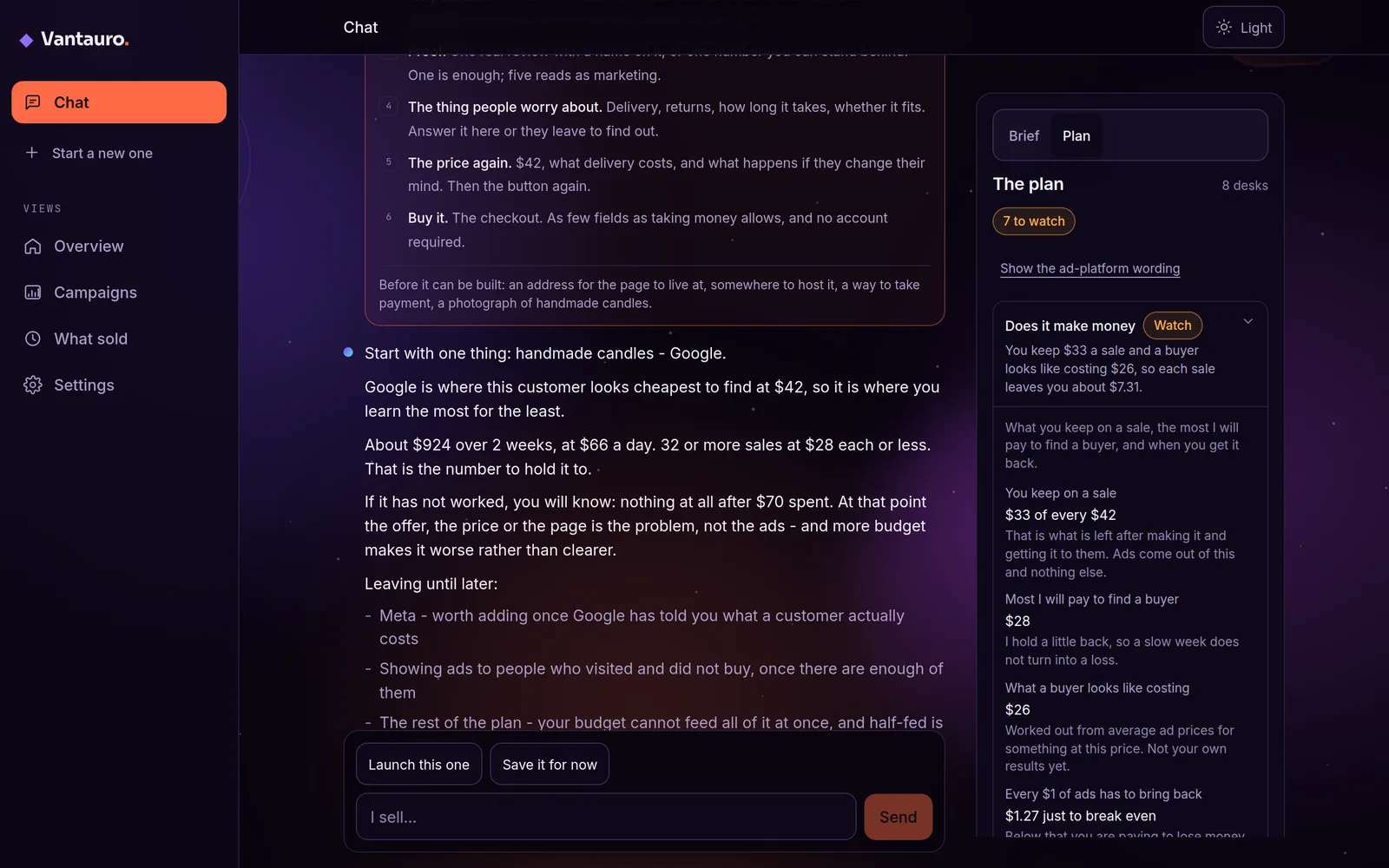
Not a plan you have to act on. The work, done - and each step said out loud so you know what you are approving at the end of it.
I read your page at lumencandles.com. It says you sell Vanilla Oak Candle, it is $42 and there is a way to buy it.
A real fetch. It finds the price, the way to buy, whether it works on a phone, how long it takes to appear - and says what is missing rather than guessing.
Finding one customer looks like about $26, and you keep $33 when you sell to them, so you are $7.31 ahead on each one.
Before a penny moves. If a customer costs more than the sale earns, it says so and refuses - which is the whole reason to trust the yes.
"For the evenings you want back" - the bit before you reach for a candle. Show that, and the candle second.
Six different arguments, not one idea in six fonts. Headline, first line, and what to put in the picture. Ready to run this afternoon.
Your page needs one thing fixing before it can take paid visitors: there is nothing on it that answers why you.
The page decides whether the money comes back. When it cannot carry the traffic, you get a plan for one that can, section by section.
Start with one thing. About $924 over 2 weeks. 32 sales at $28 each or less is the number to hold it to.
Nobody starts a whole account. One campaign, what finding out costs, and - decided before the money moves - the number that would call it a failure.
These four came out of the sentence at the top of this page. Headline, first line, and what to put in the picture - four different arguments, because the only way to find out which one works is to put them against each other.
Handmade candles. $42. That is the whole ad.
Picture: The handmade candles on a plain background, filling the frame. Nothing else in shot.
Shop nowThe bit before you reach for handmade candles. Show that, and the handmade candles second.
Picture: The situation first - the room, the moment, the problem - and the handmade candles arriving into it.
Shop nowOne person, one take, using the handmade candles the way anyone would. It beats studio photography almost every time.
Picture: Vertical, handheld, natural light. Somebody actually using it.
Shop nowYou need one real customer saying one specific thing. Not "great product" - what it did.
Picture: The review as text on screen, and the handmade candles underneath it.
Shop nowGenerated by the same code the product runs. Nothing on this page was written by hand for the website.
The technology
Behind the conversation sit eight modules with separate remits, each reading your figures and the decisions the ones before it made. A question about the ads wakes the desk that owns the ads. A finished brief wakes all eight.
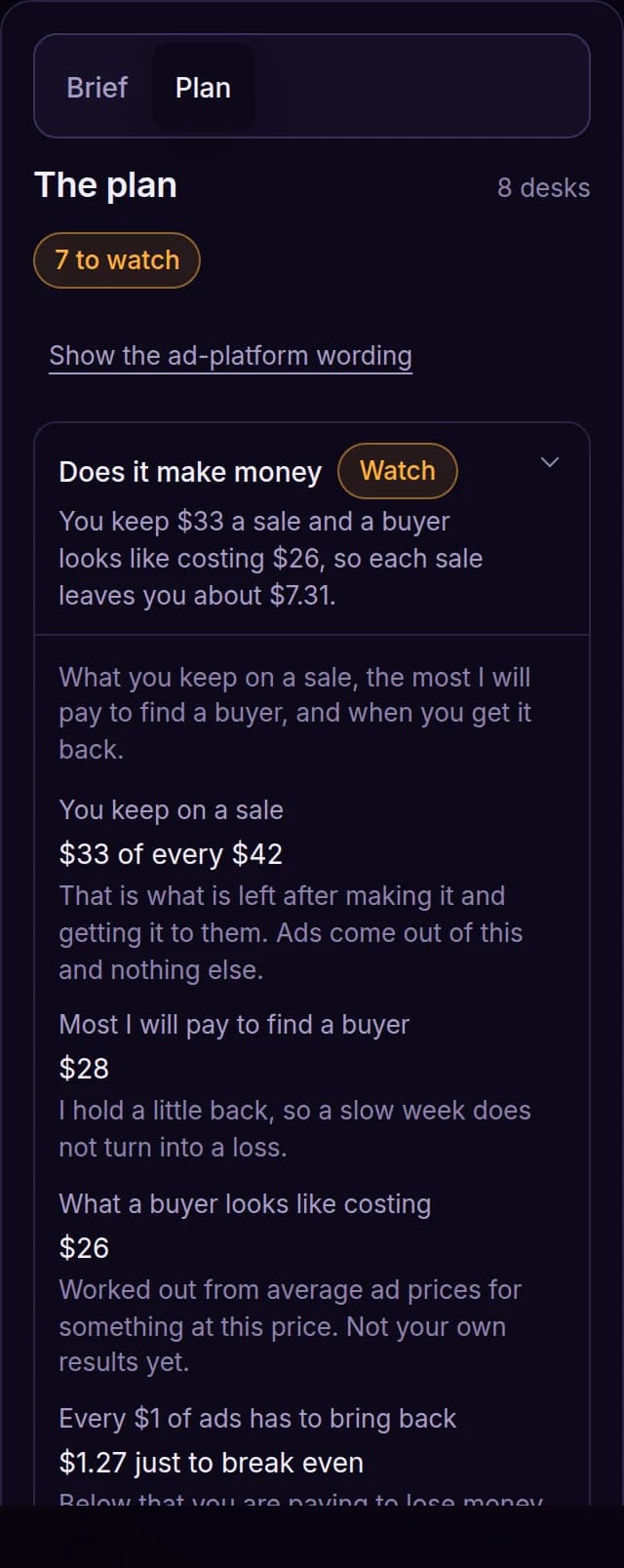
Every line is computed from your price, your cost and your budget. The trade wording is there for anyone who wants it, and hidden for everyone who does not.
The honesty check
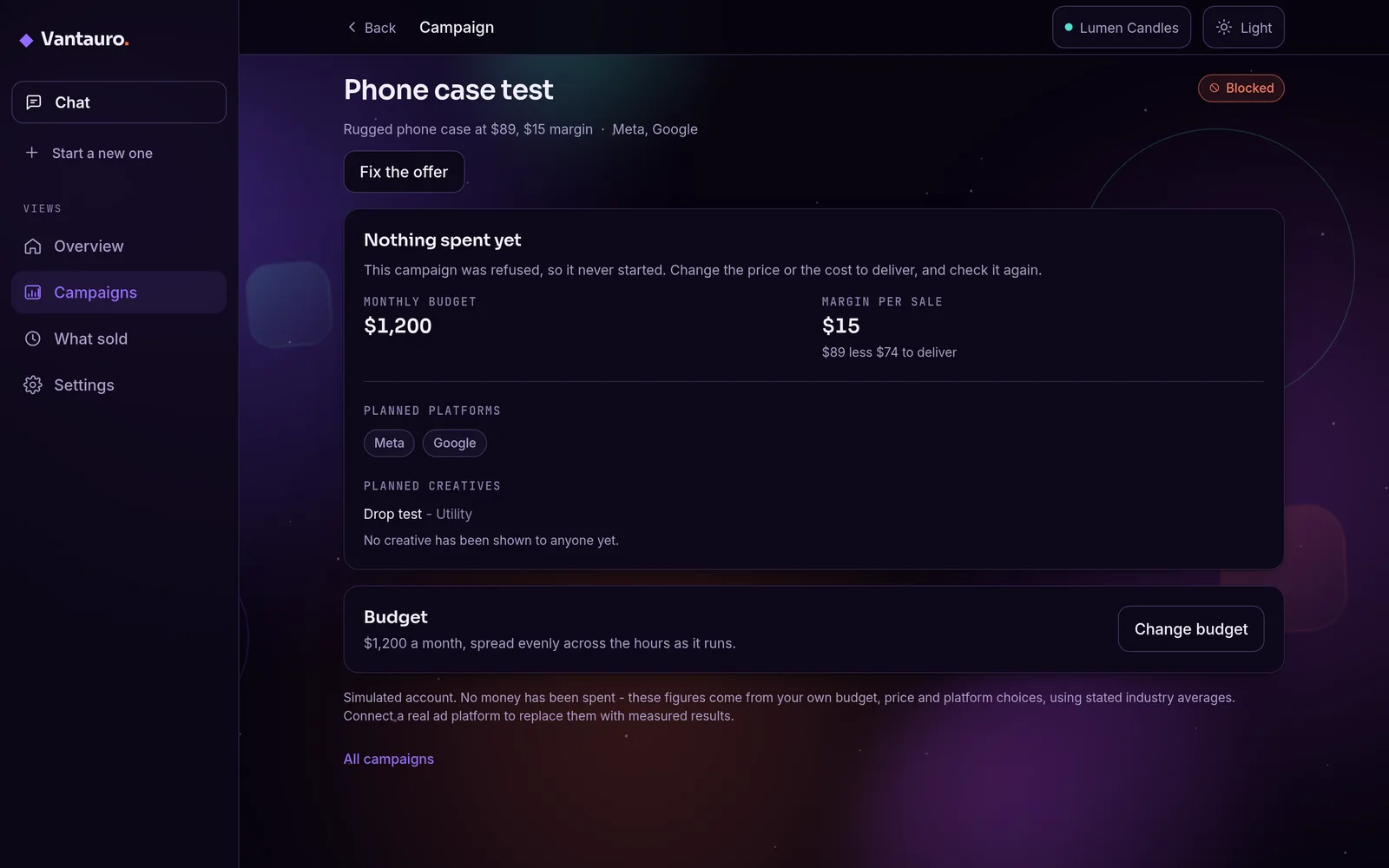
A phone case at $89 that costs $74 to make leaves you $15. Finding a buyer for it is projected at $67. Every advertising tool ever built would take that money and run the campaign.
This one refuses, shows the arithmetic that made the decision, and tells you which lever actually moves it. Push it, and it refuses again.
Per sale, before a penny of advertising is spent. Planning averages, and the page shows you every one of them.
Every ad platform reports its own version of what happened, and every one of them is flattering. Underneath this there is one ledger, keyed by the person who bought - which is why the number it gives you is lower than theirs, and right.
0
Core
One place the decisions are made, so every platform is judged by the same arithmetic rather than by its own dashboard.
0
Agents per platform
Each watching one thing: an audience, a budget, an ad, a claim. None of them is trying to be clever about all of it at once.
0+
Agents in total
Across every platform you run. What one of them learns about your buyers is available to the rest the same day.
0
Desks in the room
The economics, the audience, the channel, the budget, the ads, the measurement, the risk and the first fortnight.
The product
Four screens taken straight out of the application, at the size you are looking at them, including the one most products would have left out.
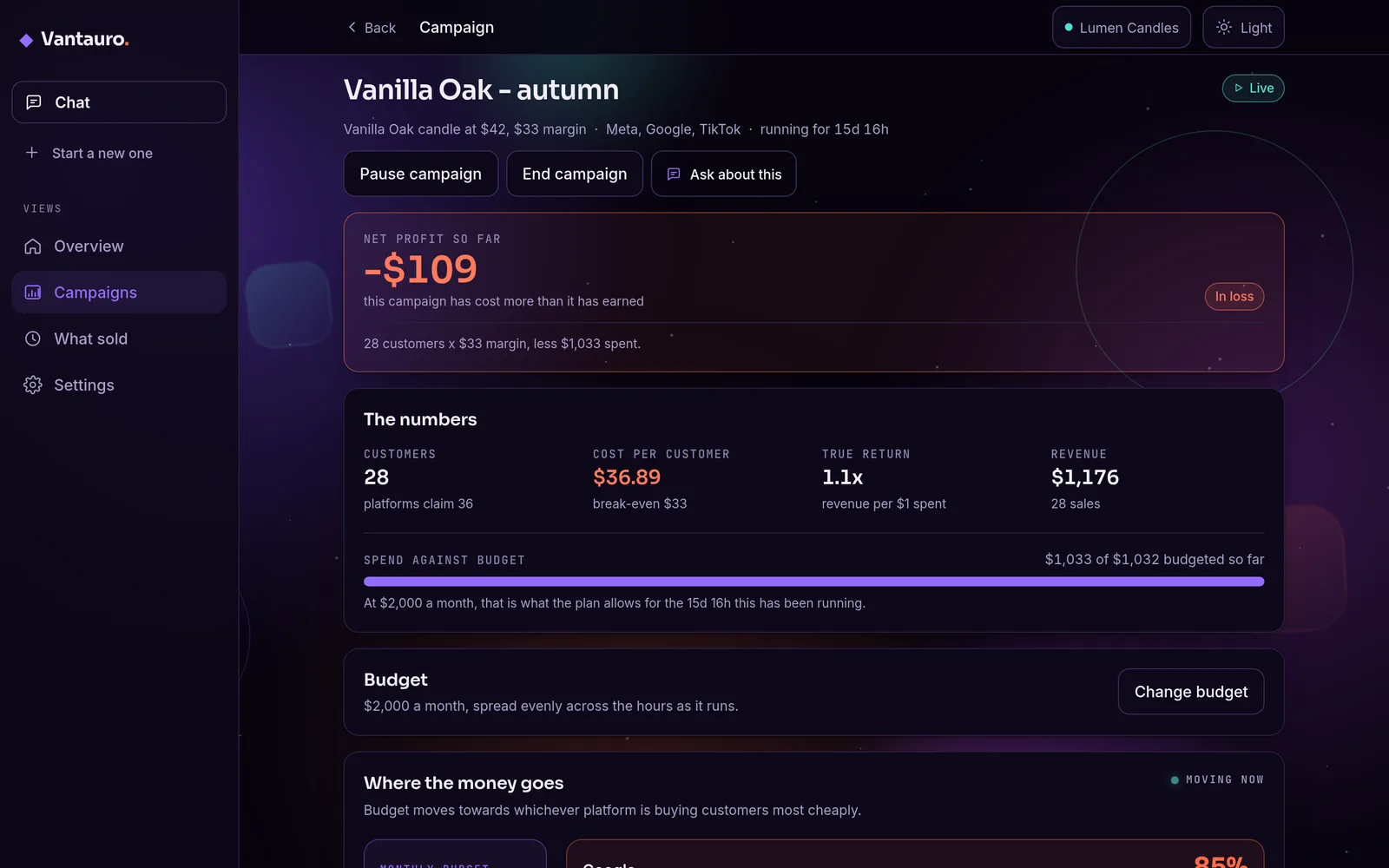
Profit first, before anything flattering. Twenty eight customers against thirty six the platforms claimed, and a campaign in loss saying so at the top of its own page.
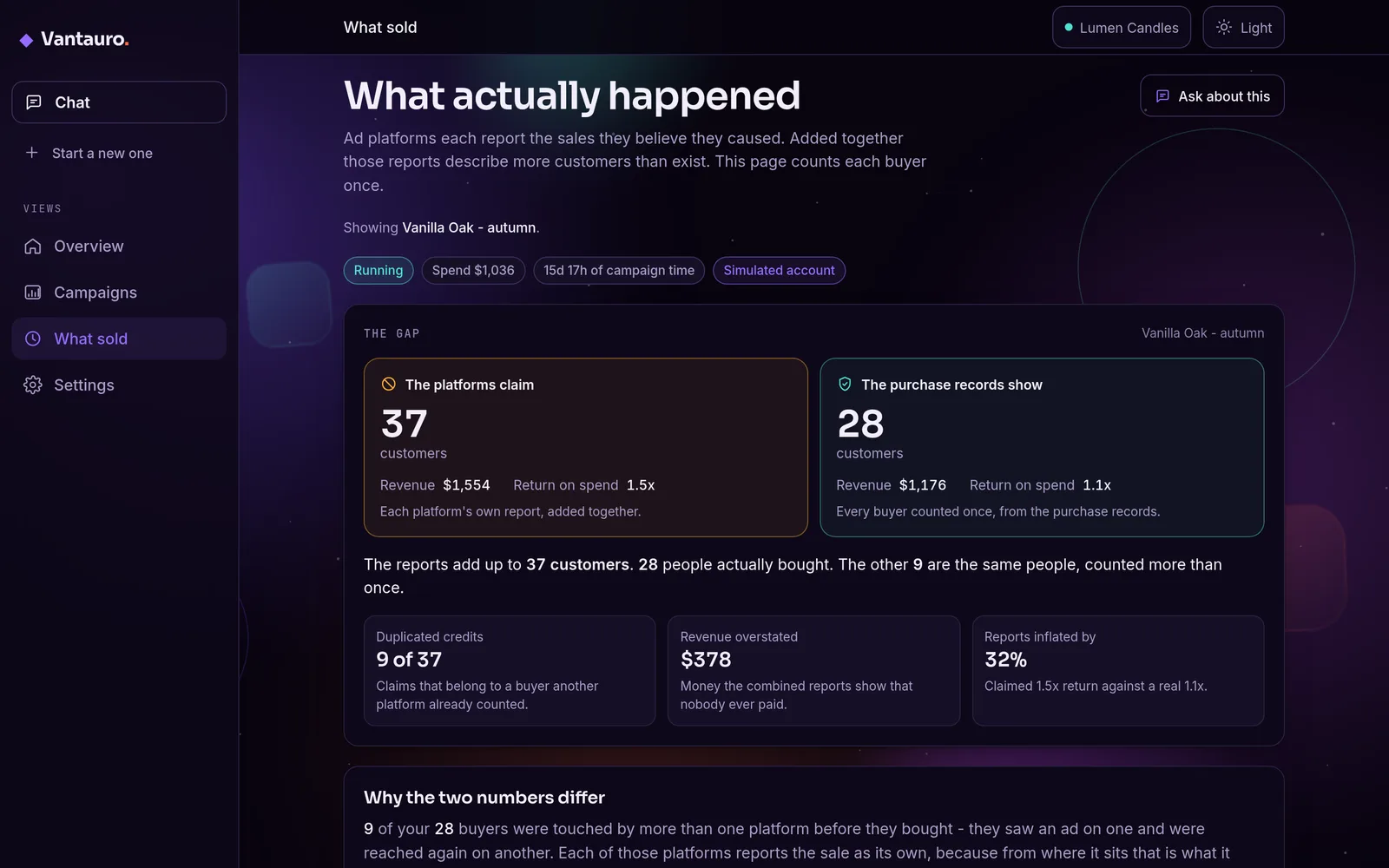
Every platform claims the buyers it touched. Added together they count the same person twice. One ledger, keyed by person, shows you the gap.
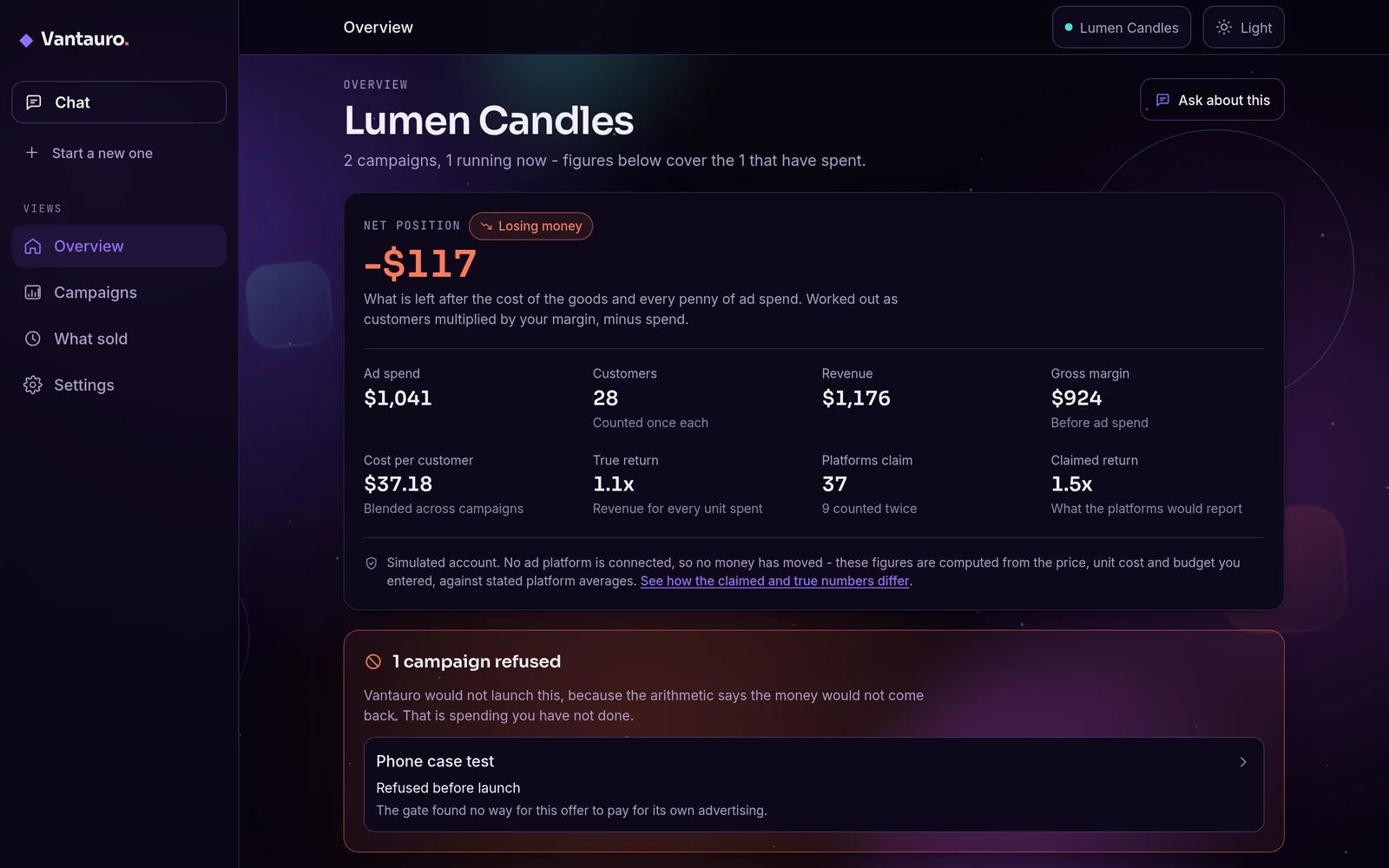
What is running, what it has cost and what it has brought back, without opening four dashboards to assemble the answer yourself.
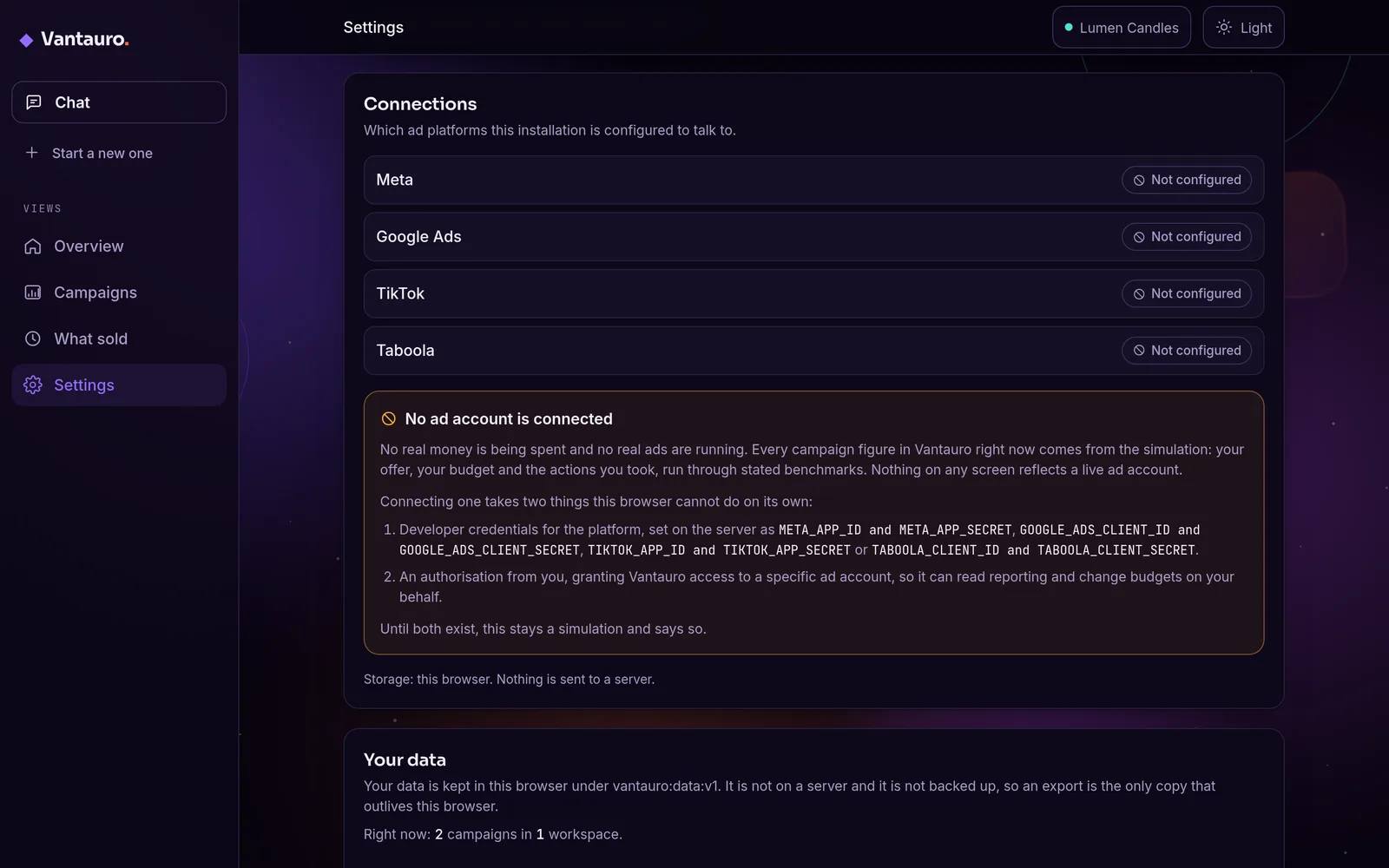
Meta, Google, TikTok and Taboola connect here, into your own accounts. Until one is connected the software says so on this screen and calls its own figures a simulation, which is the shot most products would have left out.
The business, the figures and the campaigns in these captures are sample data. They are what the software produces from that sample, not numbers typed into a picture.
The ads run in your own accounts, under your own billing. The sales come back from wherever you actually take payment, which is what lets one ledger say how many people bought rather than four platforms each claiming the same buyer.
Campaigns are built and started in your account, never in ours.
Orders, refunds and repeat buyers, keyed to the person rather than the click.
Built means the connection is written against that platform's own interface and tested. Reaching a live advertising account through any of the three also needs their review at their end, which is their timetable and not ours. On the list means exactly that. We would rather show you the roadmap as a roadmap than let you find out after signing up.
Before anything runs
The ads
The page they land on
Day to day
What sold
What it costs
Small and medium business
Describe it in a sentence and get a checked, running campaign with a plan you can actually read. No jargon, no dashboard to learn, and it will tell you if the numbers do not work.
Agencies and enterprise
Every client workspace on one screen, an anomaly caught across accounts before the client calls, and one action applied to fifty campaigns at once. Separate sign-in, separate dashboard.
One sentence is enough to find out whether advertising is worth it for you. If it is not, it will say so before you have spent anything.